Alcibiade. 132. d.
Socrate. — Réfléchissons ensemble. Supposons que ce précepte s'adresse à nos yeux comme à des hommes et leur dise :
«Regardez-vous vous-mêmes.»
Comment comprendrions-nous cet avis ? ne penserions-nous pas qu'il inviterait les yeux à regarder un objet dans lequel ils se verraient eux-mêmes ?
Alcibiade. — Évidemment.
Socrate. — Or quel est l’objet tel qu’en le regardant nous nous y verrions nous-mêmes, en même temps que nous le verrions ?
Alcibiade. — Un miroir, Socrate,
ou quelque chose du même genre.
Socrate. — Très bien. Mais, dans l'œil, qui nous sert à voir,
n’y a-t-il pas quelque chose de cette sorte ?
Alcibiade. — Oui, certes.
Socrate. — Tu n'as pas été sans remarquer, n'est-ce pas, que quand nous regardons l’œil de quelqu'un qui est en face de nous, notre visage se réfléchit dans ce qu’on appelle la
pupille, comme dans un miroir ; celui qui regarde y voit son image.
Alcibiade. — C'est exact.
Socrate. — Ainsi, quand l'œil considère un autre œil, quand il fixe son regard sur la partie de cet œil qui est la plus excellente, celle qui voit, il s’y voit lui-même.
Alcibiade. — Sans aucun doute.
Platon, Œuvres complètes.
texte établi et traduit par Maurice Groiset
Paris société d'édition Les Belles Lettres, 1920
Alcibiades I. 132. d.
Soc. Consider in your turn: suppose that, instead of speaking to a man, it said to the eye of one of us, as a piece of advice—
"See thyself"
—how should we apprehend the meaning of the admonition? Would it not be, that the eye should look at that by looking at which it would see itself ?
Alc. Clearly.
Soc. Then let us think what object there is anywhere, by looking at which we can see both it and ourselves.
Alc. Why, clearly, Socrates, mirrors and things of that sort.
Soc. Quite right. And there is also something of that sort in the eye that we see with ?
Alc. To be sure.
Soc. And have you observed that the face of the person who looks into another’s eye is shown in the optic confronting him,
as in a mirror, and we call this the
pupil,
for in a sort it is an image of the person looking ?
Alc. That is true.
Soc. Then an eye viewing another eye, and looking at the most perfect part of it, the thing wherewith it sees, will thus see itself.
Alc. Apparently.
Plato, with an english translation by W. R. M. LAMB, M.A.
sometime fellow of Trinity college, Cambridge
London : Heinemann; New York : Putnam
MCMXXVII

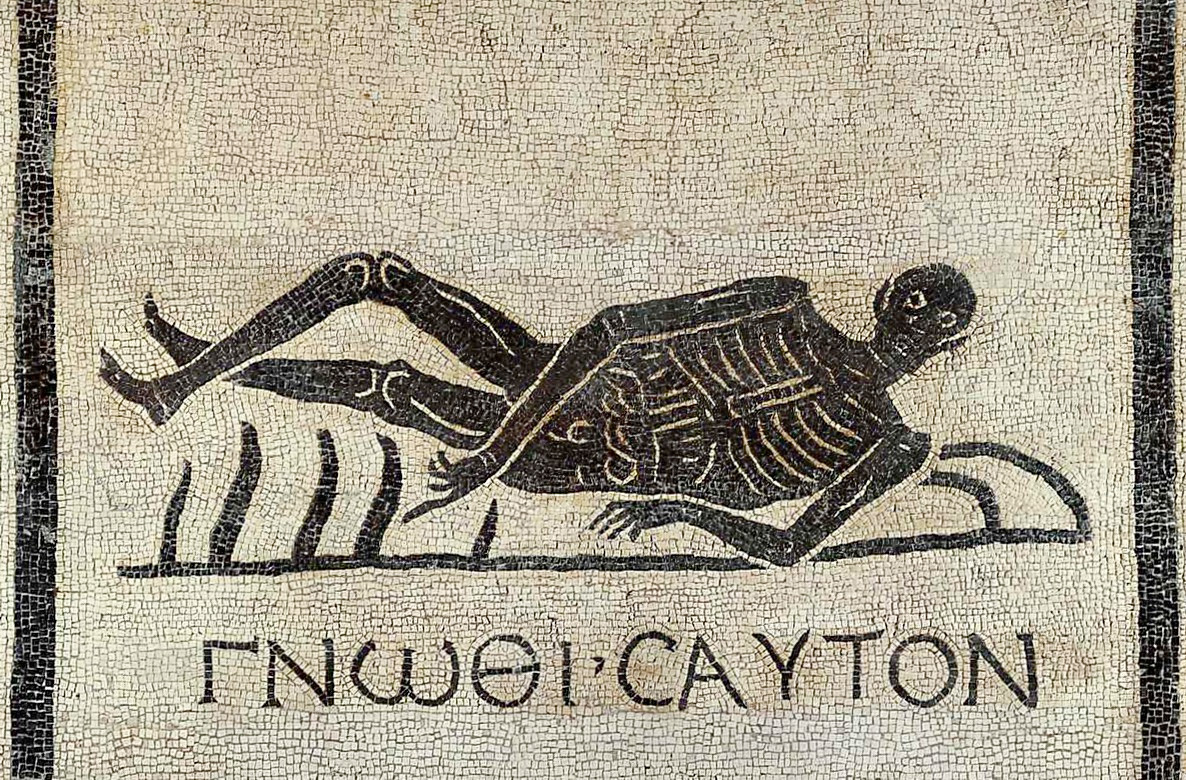 γνῶθι σαυτόν